Learning Readiness & Regulation: Unlocking Math Achievement in Grades 6–11
Help your middle and high school student stop the math struggle for good — by teaching the brain-body skills that make real learning possible before a single equation is solved.
Perfect for: Parents of students in Grades 6–11, middle and high school math teachers, learning support educators, tutors, and school counselors who work with students experiencing math anxiety, disengagement, or underperformance.
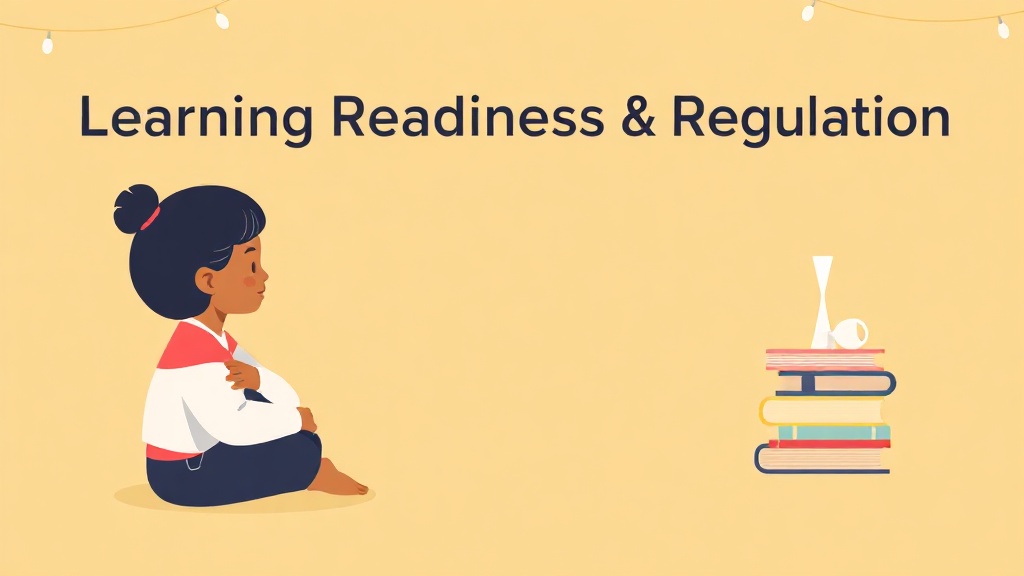
Math isn't just a numbers problem — it's a readiness problem.
Most students who fall behind in math aren't lacking intelligence. They're missing the foundational neurological and self-regulatory skills that allow the brain to take in, process, and retain new mathematical concepts. Stress, anxiety, poor working memory habits, and dysregulation quietly sabotage even the most well-taught lessons — and no amount of re-teaching fixes a brain that isn't ready to learn.
What this course actually teaches
This course bridges the gap between neuroscience, self-regulation research, and practical classroom and home strategies. You'll learn how to identify the signs that a student is not in a learning-ready state, and exactly what to do about it — before opening a textbook. From breathing techniques and sensory regulation tools to growth mindset reframes and metacognitive math strategies, every lesson is grounded in evidence and immediately applicable.
Who this is designed for
Whether you're a parent watching your Grade 7 student shut down at the sight of a word problem, a teacher whose Grade 10 class checks out the moment algebra appears, or a tutor trying to figure out why your perfectly explained lessons aren't sticking — this course gives you a clear, structured framework. You'll walk away with a toolkit of routines, scripts, and activities you can use tomorrow.
The result: students who show up ready
When regulation comes first, math achievement follows. Students who learn to manage their nervous system, build a growth-oriented relationship with challenge, and use targeted metacognitive strategies don't just improve their grades — they change their entire identity around math. This course is your roadmap to making that transformation happen.
What you'll be able to do
- Identify the key neurological and physiological signs that a student is not in a learning-ready state before a math lesson begins
- Apply at least 5 evidence-based regulation strategies (breathing, movement, sensory input) to shift a student into an optimal learning state
- Distinguish between fixed and growth mindset responses to math difficulty and use targeted language scripts to reframe student self-talk
- Design a personalized pre-learning regulation routine for an individual student based on their specific nervous system profile
- Implement metacognitive strategies — including self-monitoring, error analysis, and spaced retrieval — directly within math practice sessions
- Recognize and respond to math anxiety as a physiological event, not a character trait, using de-escalation techniques in real time
- Structure a consistent home or classroom environment that reduces cognitive load and supports sustained attention during math work
- Track a student's regulation patterns over time and adjust strategies based on observable progress data
Curriculum
5 modules · 17 lessons
Your teacher
Ms. Sanya
Hi, I'm so glad you're here — because if you're looking for this course, you've probably already tried the usual fixes: more practice, better explanations, extra tutoring. And you've seen that they only go so far. I've spent years working at the intersection of learning science and math education, and the most transformative shift I've witnessed in students isn't a new curriculum or a clever trick. It's this: when we teach the brain and body to be *ready* to learn first, everything else clicks faster and sticks longer. In this course, I'll walk you through exactly how the nervous system affects mathematical thinking in adolescents, and give you a concrete, step-by-step toolkit to create the conditions where real math learning can happen. Every strategy I share is grounded in research and field-tested with real students in Grades 6 through 11. I'm excited to be your guide through this — let's get started.
FAQ
Ready to start your journey?
Join get instant access — learn at your own pace with an AI coach in your corner.
Enrolling a child? Sign up as a parent — you'll add your student right here after.